
1. The Core of Distance Education (DE)
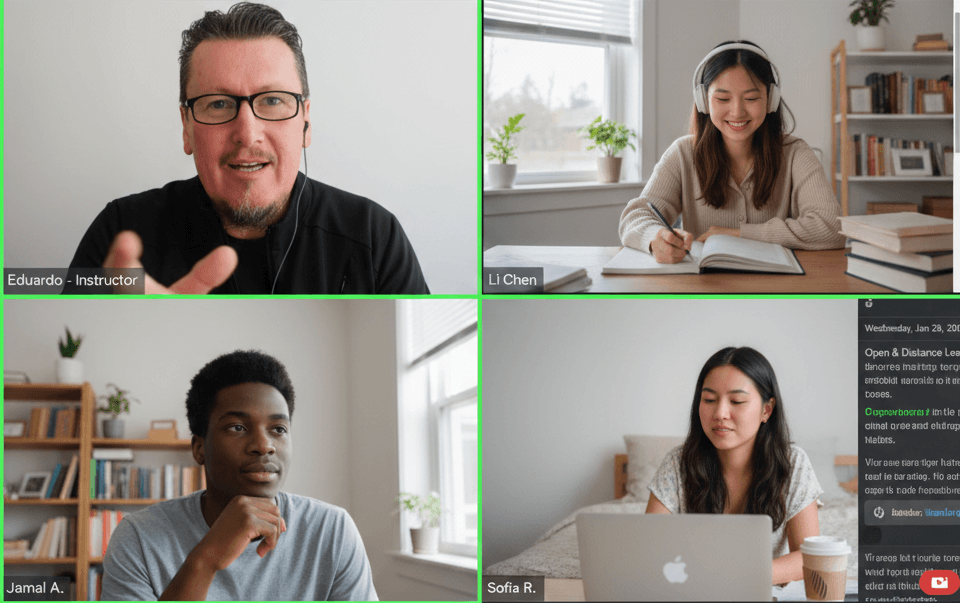
Distance Education is often misunderstood as merely “learning via a computer.” However, at its core, it is a formal educational process in which the majority of the instruction occurs when student and instructor are not in the same place at the same time. According to Stonebridge (n.d.), it is a way of learning remotely without being in regular face-to-face contact with a teacher in the classroom.
In today’s landscape, this is achieved through two main delivery methods:
- Synchronous Learning: Real-time interaction (live calls, chats).
- Asynchronous Learning: Students access materials and participate at their own pace and schedule (TechSmith, 2022).
For the modern educator, the challenge is not just “sending files,” but creating a systematic dialogue—as Garcia Aretio famously argued—that bridges the physical gap with pedagogical presence.
2. The Philosophy of Open Education (OE)
While Distance Education describes how we deliver content, Open Education describes why and for whom we do it. Open Education is a philosophy about the way people should produce, share, and build on knowledge.
As noted by Opensource.com (n.d.), the core goal is to eliminate barriers to entry, such as cost, location, and rigid schedules. This is often achieved through Open Educational Resources (OER)—materials that are licensed to be freely shared, reused, and remixed by others (NEBHE, 2022). Openness in education is about making high-quality learning accessible to everyone, regardless of their background or current life constraints.
3. The Current Landscape: Strengths and Challenges
In the post-pandemic era, these models have moved from “emergency alternatives” to “essential pillars” of lifelong learning.
The Strengths:
- Flexibility: It empowers learners who are traditionally excluded from the education system due to work shifts or family responsibilities.
- Scalability: A single, well-designed digital asset can serve ten students or ten thousand without a proportional increase in cost.
- Personalization: Students can revisit complex content as many times as needed, moving at their own “Goldilocks” pace—not too fast, not too slow.
The Challenges:
- The Social Gap: Without careful design, distance learning can feel isolating. The instructor must work harder to foster a sense of community.
- Self-Regulation: It requires a higher level of discipline from the student, which can lead to higher drop-out rates if they are not properly supported.
- The “Digital Shadow”: There is a persistent myth that distance education is “low quality” or “passive,” often leading stakeholders to believe it is nothing more than uploading textbook scans.
4. Moving Toward the Virtual Language Lab
As you reflect on these concepts, consider the situation at our Community Center. We have a diverse group of potential students—some working rotating shifts, others managing households, and some struggling with heavy university loads.
If we apply the principles of Open Education, our goal is to remove the barriers that are currently keeping these people away. If we apply the rigors of Distance Education, our goal is to ensure that the instruction they receive is as structured and interactive as any physical classroom.
The Challenge for You:
Look back at your own experience. Have you ever felt that a digital course was just a “digital filing cabinet”? As you begin your analysis of the Community Center, ask yourself: How do we move beyond the “PDF myth” to create an environment where the philosophy of openness and the technology of distance actually serve the human learner?
Clearing up possible doubts
So, Open Education and Distance Education are the same, right? Actually, they are very different, though they both share the Internet as a medium.
Open Education can happen online or in a classroom. That there is a teacher or not is really not what matters. What is important is that any person has free access to the course content at any time and can go through the content at his or her own pace, be it online or classroom.
Distance Education can be understood as open or closed education but always not in a classroom. For us, we generally will understand that a distance course is a close education course, where a teacher guides students through the content from the first to last unit. Also, the course content is only available to those people who have signed up, usually by paying, to the course.
Here is a simple graphic to help you get a better grasp on how these concepts can be combined.
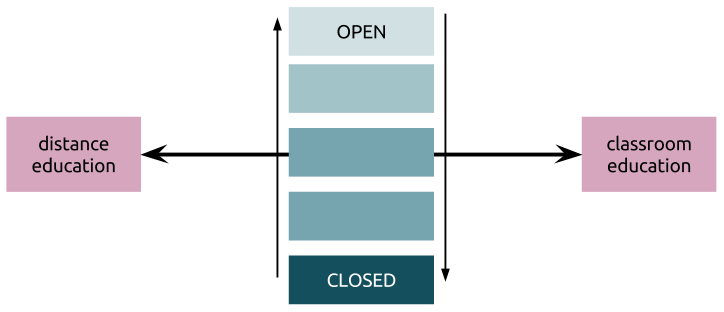
On each extreme we have the two education modalities: distance and classroom. In the middle we can place an up-and-down scrolling bar. Push the center column to the left and you can have open distance education and closed distance education. Push the center column to the right and you can obtain open classroom education and closed classroom education.
Final Words
Download and play this audio file for a verbal description of the above concepts
📚 References
- NEBHE. (2022). What is Open Education? New England Board of Higher Education. https://nebhe.org/open-education/resources/what-is-open-education/
- Opensource.com. (n.d.). What is Open Education? https://opensource.com/resources/what-open-education
- Stonebridge. (n.d.). What is Distance Learning? Stonebridge Associated Colleges. https://www.stonebridge.uk.com/blog/distance-learning/what-is-distance-education/
- TechSmith. (2022). Distance Learning: What is it and why does it matter? https://www.techsmith.com/blog/distance-learning/